Agency Economy in Football Agent
Weekly costs, bankruptcy, rebuilt fees, and Club Mandates as income
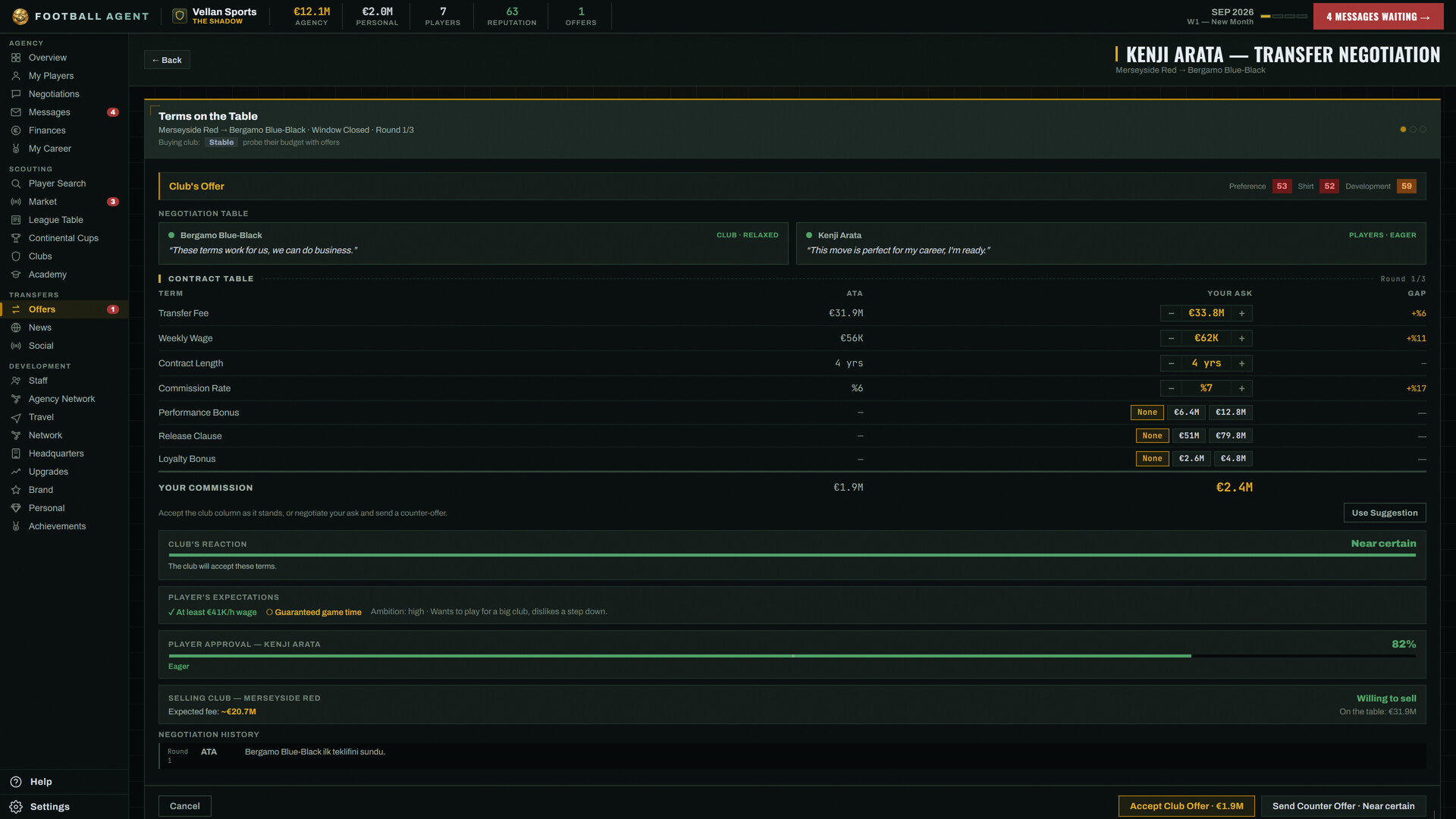
Football Agent is a single-player agency career from ATERO GAMES. It entered Steam Early Access on 25 August 2026 with a living football world — 44 countries, 115 leagues, 1,900 clubs, 47,500 players — and a bank account that can kill the save. You start with about €50,000. Weekly operating costs start eating it immediately. Bankruptcy ends the save. There is no rescue package, no restart bonus, no friendly investor. This page is the cash map: where money comes from, where it goes, what the 27 August market rebuild changed, and why Club Mandates are income you should answer on purpose.
If you want the practical growth loop, jump to how to grow your agency. If you want the first deal in isolation, use your first client. Here we stay on the ledgers.
Cash, weekly costs, and the fail state
Your visible cash is not a score. It is oxygen. Every week the agency pays:
- Staff wages (scouts, analysts, lawyers, PR, physios).
- Headquarters running costs.
- Scouting missions you chose to send.
- Retainers, travel, and any gesture you buy in a random event.
Income arrives later and lumpier:
- Signing commission when a client joins a club.
- Ongoing commission on wages.
- Transfer commission when a client moves.
- Sell-on clause payouts years after the original deal.
- Club Mandate fees when you successfully propose a player a board asked for.
Until the first commission lands, the €50,000 is a runway, not a fortune. A common early death is hiring two extra scouts, upgrading the office, and then meeting a week of events that still demand cash. Keep a floor of several weeks of operating costs in the account at all times. Eight weeks is a widely used community rule after the first days of Early Access; two weeks is panic.
When cash hits zero, the save ends. That is the primary fail state. Reputation damage, a lost wonderkid, a postponed meeting — all of those hurt. None of them close the file except bankruptcy.
The first commission is the real start
The opening bankroll buys time. The first commission buys a career. Until a client is at a club and earning, the agency generates nothing reliable. That is why the first client guide exists as a sibling to this page: economically, everything before that cheque is survival.
Do not spend the first commission as if you had arrived. Recalculate weekly costs the same day. If the new income does not cover wages plus a buffer for events, you have not grown — you have delayed bankruptcy. Reinvest in one scout or one analyst, not both, until the second cheque exists.
27 August 2026: transfer market rebuilt
The transfer market was rebuilt in the 27 August balance. Three rules matter to your wallet:
- Clubs carry spending into following seasons. A board that empties the till one summer feels it the next. Mega spending is no longer a reset button every 1 July.
- The market is a world market. Demand is not a local bubble around your home league. A realistic fee in one country can still find a buyer two borders away — or fail because those boards already spent.
- Fees are capped at realistic levels. Giant transfers are the exception, not the weekly rhythm. You will not print a dynasty on one cartoonish sale.
For an agent this is good news and a trap. Good news: clubs that still have room become readable. Trap: if you priced your wonderkid as if every board were a sovereign wealth fund, the deal dies and weekly costs keep ticking. Sell-on clauses matter more when headline fees are sane; the second sale can be the cheque that actually funds staff and headquarters.
Relationship spending is no longer a money tap
Before the 27 August pass, it was possible to push club relationships and motivation gestures without a meaningful ceiling: spend, smile, repeat. That tap is closed. Money still helps a conversation. It does not buy infinite warmth.
Budget for a few genuine gestures, not for a relationship printer. If a board is cold, the cheaper path is often a better-fitting player, a mandate they posted, or patience until their carried-over spend recovers — not a stack of gifts that no longer move the needle. Motivation gestures for clients follow the same logic: a paid pep talk is not a substitute for minutes and a club that needs the shirt.
Club Mandates as planned income
Club Mandates are not random events. A club asks for a player. You propose a name from the Market panel or the Club Mandates panel. If the proposal is ineligible, the game now explains why — wrong position, wrong wage band, already committed, or a fit the board will not accept.
Treat mandates as a job board:
- Answer the ones you can fill with a client already on your books.
- Use them to place a prospect whose minutes were stalling.
- Ignore mandates that would require a buying spree you cannot fund.
Successful mandates pay. Failed fishing trips cost time and sometimes travel. Because clubs now carry spending forward, a mandate from a board that still has budget is worth more than a loud request from a board that already spent the summer. Read the why-not text instead of proposing the same ineligible name twice.
How events tax the same account
Random events share this ledger. After the lock hotfix you can always close a window, but the free option still costs reputation, bond, or interest. Paid options compete with wages. The 27 August cap on monthly event volume makes the tax predictable enough to reserve against. Keep an event slice of cash that is not staff and not a transfer sweetener. Details live on the random events page; the economic rule is simple: never let a pop-up be the week you also hired.
A working order for the first season
- Protect eight weeks of costs before any upgrade.
- Land the first commission; recalculate the weekly number the same day.
- Hire one income-producing role (usually a scout), not a full staff roster.
- Take mandates you can fill; skip the rest.
- Price transfers for the rebuilt cap, not for a highlight reel.
- Stop relationship spam. Spend on fit and minutes.
Check the patch notes when ATERO GAMES retunes fees or costs again. Early Access will move these numbers. The fail state will not: zero cash still ends the file.
The rebuilt market of 27 August rewards patience more than spectacle. Clubs that overspend one summer feel it the next. Your job is to notice which boards still have room, which mandates they posted, and whether a realistic fee still leaves you a living. The opening bankroll is a runway, not a fortune. Land the first commission, then let weekly costs become a number you choose rather than a number that chooses the end of the save.
Frequently Asked Questions
Quick answers to the most common questions.
What happens if I go bankrupt?
The save ends. Bankruptcy is the primary fail state. There is no bailout. Keep several weeks of operating costs in cash, especially before the first commission arrives.
How much money do I start with?
About €50,000. It looks large until weekly wages, scouting trips, and event choices share it. Treat it as runway until a client is at a club and paying commission.
Did the 27 August update change transfer fees?
Yes. The market was rebuilt: clubs carry spending into later seasons, fees sit at realistic caps, and mega transfers are the exception. Price clients for that world, not for a fantasy auction.
Can I raise club relationships forever by spending?
No. The unlimited money tap on club relationships and motivation gestures is gone. Gestures still exist; they no longer print warmth without limit. Fit, minutes, and mandates matter more.
How do Club Mandates make money?
A club requests a player. You propose from the Market or Club Mandates panel. A valid, accepted proposal is paid work. Ineligible proposals now explain why, so you stop wasting travel on names the board will never take.