Wonderkids in Football Agent
Potential, minutes, and why three-season superstars no longer exist
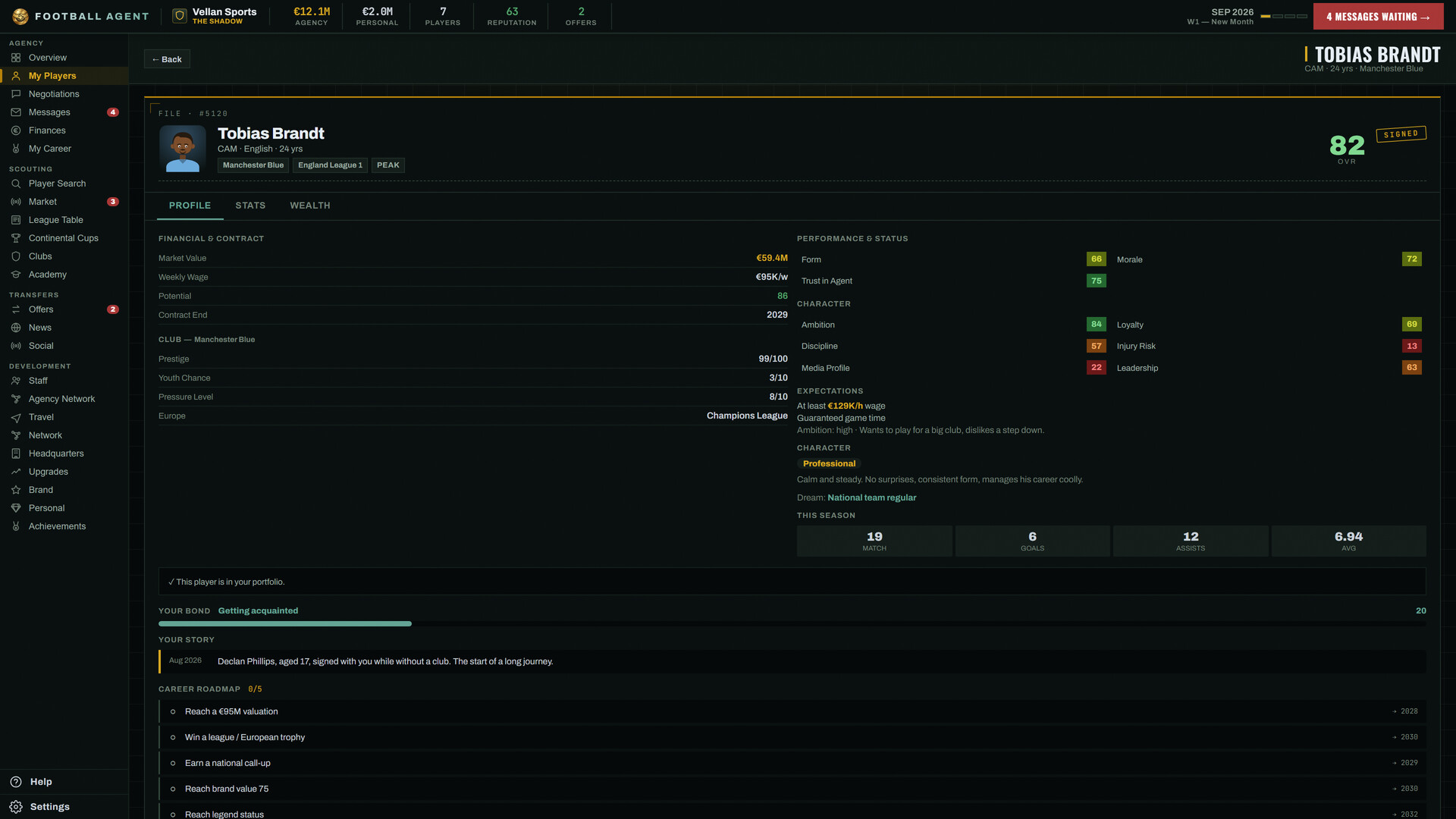
Among 47,500 players spread across 44 countries, 115 leagues, and 1,900 clubs down to the third tier, the names that change an agency are rarely the ones on television. They are 17-year-olds nobody looked at twice: a left-back in a muddy third division, a striker whose current ability looks ordinary until a scout sits through a full match. Football Agent, from ATERO GAMES in Steam Early Access, is built for that hunt. This page is about finding those players, reading potential against what they can do today, and not betting the €50,000 start on a fairy tale the hotfix already killed.
Seventeen and invisible
A wonderkid in this game is not a guaranteed superstar. He is a young footballer whose ceiling is high while his present is cheap. Clubs in the third tier do not pay star wages. Rival agents — more than 300 of them — still crowd the obvious names. Your edge is patience and a scout who will watch a league nobody else booked a hotel for.
You still start the save with one unsigned client and no club. That starter is probably not a wonderkid. Do not abandon him to chase a rumour. Place him first, then spend commission on the kind of trip that actually finds a 17-year-old.
Potential versus current ability
Current ability is what a sporting director will pay this window. Potential is what you hope he becomes if he plays. The gap is where agents make money — and where they go broke. A high ceiling with no minutes is a sticker, not an asset. After the development hotfix, that sentence is literal: a player who does not get minutes barely develops.
Read both numbers on every report. Ask what club will give him a squad place he can actually occupy. A 17-year-old with huge potential and a demand for first-division football will sit. The same boy in a third-tier side that starts him twice a week will grow. You sell the growth later, not the rumour now.
Face-to-face meetings matter because reports lie in both directions. A nervous kid in a hotel lobby can look smaller than the file. A quiet one who looks you in the eye may be the one you fly home for. Do not sign on a number alone.
Scouting the third tier
Top leagues are expensive and crowded. The third tier across those 1,900 clubs is where current ability is low and potential still hides. Send scouts on longer missions when you can afford them. Short fly-bys miss the boy who only explodes in the second half.
Match the mission to a position you can actually place. Club Mandates from the 27 August 2026 patch will sometimes ask for youth; more often they ask for a senior profile. Do not force a wonderkid into a veteran request. Use mandates when they fit, and keep conventional scouting for the rest of the transfer window.
If a report looks too good, go yourself. Travel costs bite the €50,000, so use it as a second look, not as your only method.
Meetings, promises, and loans
When you sit with the player, promise a level of club and a level of minutes you can defend. Playing time now depends on squad place plus the playing-time promise. A loan is no longer a cosmetic move: it changes those minutes. A bench loan to a bigger badge can freeze a ceiling that used to shoot up in three seasons.
That three-season sprint is gone. Wonderkid development was too fast; a boy could hit his ceiling in three seasons with full investment. It is much slower now. Plan five or six seasons of regular football, not a montage. If you over-invest — huge wages, huge travel, a second office — expecting a superstar by season three, the hotfix will punish the spreadsheet.
Watch him in the 2D match engine. Live commentary tells you if he is a passenger or a problem. Form, morale, and injuries all sit on top of the growth curve. No minutes still means no development, even if you spent like a giant.
Do not buy the montage
The fantasy is simple: sign three 17-year-olds, wait three seasons, sell them to the biggest of the 1,900 clubs. That fantasy belonged to the first days of Early Access. It does not belong to the build you play now. Keep a mixed book: the starter who needs a club this week, a couple of honest professionals who pay the lights, and one or two true long bets whose minutes you protect like cash.
Protecting minutes means fighting for starts, accepting a smaller club, or arranging a loan that actually plays him. It does not mean parking him at a famous side for the photo.
How to work a wonderkid season
- Finish the starter’s placement before you fund a wonderkid trip.
- Scout third tiers with a clear position and age band.
- Meet in person before you lock commission and a sell-on clause.
- Promise minutes you can see on a teamsheet, not minutes you wish were there.
- Recheck loans and squad place after every window.
For the tools around this hunt, use How to Scout for missions and reports, How to Develop Clients for morale and growth, Scouting System for how the network model works, League Coverage for where the third tiers sit, and Matches for reading the 2D engine.
A wonderkid who becomes a name will do it the slow way: muddy pitches, awkward meetings, a loan that actually kicks a ball, and a ceiling that refuses to arrive on a three-season timer. If that sounds less glamorous than the trailer in your head, you are finally playing the same game the hotfix intended.
Frequently Asked Questions
Quick answers to the most common questions.
Are wonderkids still reaching their ceiling in three seasons?
No. Development was too fast in the first Early Access build. A wonderkid could hit his ceiling in three seasons. Growth is much slower now, and no minutes means almost no development.
Should I hunt 17-year-olds before I place my first client?
No. You start with one client who has no club. Find him a club first. Wonderkid trips spend the €50,000 start; commission from the first placement funds the hunt.
Do loans still waste a youngster's growth?
They used to ignore minutes. Now playing time depends on squad place and the playing-time promise, and loans affect those minutes. A bench loan barely develops him. A loan with starts can.
Why scout third tiers instead of the big leagues?
Among 47,500 players, the obvious names are crowded by 300-plus rival agents. Third-tier clubs among the 1,900 are where current ability is cheap and potential still hides.
Is a face-to-face meeting worth the travel cost?
For a true long bet, yes. Reports miss personality. A meeting tells you whether the boy will accept a smaller club and the minutes that actually grow him.